Showing posts with label Beijing Architecture. Show all posts

Friday, August 6, 2010

Tiananmen Square (3): Mausoleum of Mao Zedong


The Chairman Mao Memorial Hall, or the Mausoleum of Mao Zedong, as it is also known, stands on the previous site of the Gate of China that was demolished in 1954.

Although Mao requested to be cremated, he was embalmed after his death in 1976.  His body is displayed in a crystal coffin and people line up every day to view his body and pay tribute.

People from all over China contributed to the design of the Mausoleum as well as to the materials themselves including granite from Sichuan, pebbles from Nanjing and rock samples from Mount Everest.

The sculptures in front of the museum, sometimes called the Workers' Revolutionary Statues, are part of a group of four "teams", two in front and two in back of the building.  Altogether there are 62 figures measuring 3.5m.  


The entire group of sculptures took 5 months to complete by over 100 sculptors from 18 different provinces in China. 


Tiananmen Square (2): The Architecture and History

Tiananmen Square holds a lot of cultural significance due the political events that have occurred there, particularly the Tiananmen Square Protests in 1989, the proclamation of The People's Republic of China by Mao Zedong in 1949 and the May Fourth Movement in 1919. And that's just the last 100 years. (Pictured above: The Monument to the People's Heroes and the Great Hall of the People).


While the Tainanmen (Qianmen) Gate to the Forbidden City was built in 1417, the Square itself was not built until 1651.  In the 1950's it was enlarged to four times its original size, becoming the largest public square in the world (440,000 m² - 880m by 500m) and can accommodate up to 600,000 people.  

The Square lies between the Tian'anmen North Gate and the Zhengyangmen (Qianmen) South Gate which leads into the Forbidden city.  

Pictured here: The Monument to the People's Heroes.

On the west side of the Square is the Great Hall of the People (above) and the Monument to the People's Heroes  and on the east side is the National Museum of China (below), which focuses on Chinese history before the May Fourth Movement in 1919).


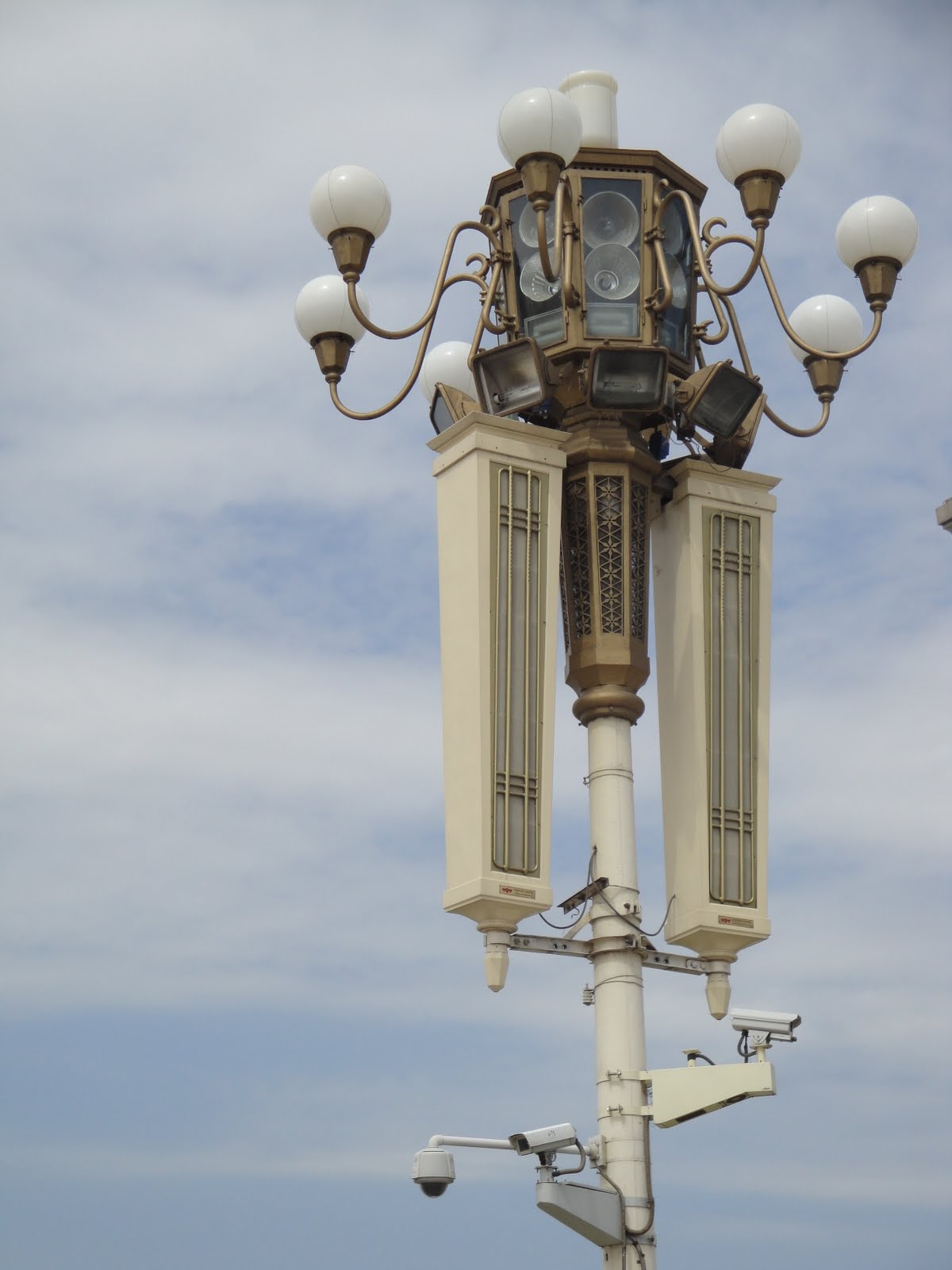
Another sign of China's continued control over monitoring the activities of its citizens can be seen here.  The lamposts here sport video cameras and policemen in uniforms and plainclothes patrol the area.  

Hmmm... I guess not so different from some Chicago neighborhoods, eh?


Tiananmen Square (1): Qianmen, The South Gate

Qianmen is the colloquial name for Zhengyangmen, which is the South Gate of Tiananmen Square. It once guarded the entry to the inner city and, after the walls were destroyed in the 60's, only the gatehouse and the archery tower remain.


It was originally built in 1419, during the Ming Dynasty and, after the Communist victory in 1949, it was occupied by the People's Liberation Army.  Since it was vacated in 1980, it has become a tourist attraction and the architecture is extremely well preserved.

As a military structure, its fascinating how much care was taken in designing the decorative details as well as the practical aspects.


City Lights: Night View from the Park Hyatt, Beijing

When in Chicago, I often take out-of-town guests to view the city lights at night from the restaurant and lounge in the Hancock Tower.  Not because its a great restaurant (sorry), but more for the view.  So I was excited to learn about this restaurant, The China Grill at the Park Hyatt, Beijing.

The China Grill at the Park Hyatt in Beijing is a similar to the Signature Room, in that you mainly come for the view because the food is only "good enough".  It wasn't bad, just about on par with a nice restaurant in any major city.  Although D noted that many of the restaurants on Beijing, even the nice ones, seem to be lacking in consistency of service and no one seemed to be able to understand how to time the arrival of dishes to the table. The saving grace for me were these two dishes:  the spicy/crispy calamari and a glass of citrus sorbet layered with frozen citrus slices, which served well to cut the oiliness of the rest of the meal.  


The view, however, is spectacular.  My pictures here cannot do adequate justice to the beauty of the city lights of Beijing at night.  Here is a video of this view, which I captured as best I could with my Flip Video.  Click here for the YouTube link.


Located on the 66th floor, its not as high at the Signature Lounge at the Hancock, but the China Grill is the highest restaurant in the city and has 360 degree views of Beijing. And the views couldn't be more different.  The lights in Beijing are much more colorful on the buildings as well as the signage and the streets curve in rings, rather than the grids of more modern cities.  Beautiful.


These pictures look like code from the Matrix, but if you look closely you can see that these are the windows of some of the smaller residential buildings and their reflections along with the brightly lit Chinese characters in the commercial signage.  Its like a painting.

Here are a few images of the interiors.  One of the stairs leading from the elevators near the lounge and one of the lobby interiors.


More to come ...

Thursday, August 5, 2010

Temple of Heaven (7): Music in the Temple Gardens (VIDEO)

Beyond the beauty of the historic architecture, the gardens on the grounds of the temple are beautifully landscaped, and in the open areas musician gather to play and sing traditional Chinese music. 


Below is a video of a man playing a traditional Chinese instrument as people gather and (try) to sing along.  Here is the YouTube link.


Here is a group of men who have gathered at the gates of the temple to sing.  Here is the YouTube link.


One of the beautiful old trees in the temple gardens.

Temple of Heaven (6): Sketching at the Temple draws a crowd of children (VIDEO)

Since he was last here in 1982, Beijing has changed... a lot.  But historic sites like this one change very little, aside from the multitude of baseball hats and cell phones.  So D chose to sketch the hall of Prayer for Good Harvests, since it was one of the landmarks he remembered most from his childhood trip.


At times like these, since I'm not really into drawing inanimate objects, I generally just sketch D as he is sketching.  I know, its seems weird, but I'm not that great at drawing architecture, so I would only do it an injustice.  Plus, its kinda funny.  People definitely had a laugh when they watched D drawing and then came around to see what I was drawing, amidst all this historic architecture, and its just a sketch of him sketching.  Oh well, I amuse myself ;)


Here is my sketchbook with my phone set to the Temple of Heaven page from the Beijing Taxi Cards app on my iphone. 


Wherever he goes to sketch, he always draws a crowd of curious children and sometimes adults.  They always want to pose for pictures with you too, which I agree to do with children, but not adults.  Its not that they think you are a celebrity, just that, you look different... or at least he does.  Anyway, the children were cute and funny, especially this solid little man in the yelllow tshirt.


And here is some of the video of the children watching him sketch.  So cute!  Here is the YouTube link, if you prefer.

Temple of Heaven (5): The Hall of Prayer for Good Harvests... VIDEO!

Here a brief look at the Hall of Prayer for Good Harvests on video.  You can see how crowded it was, and this was not even the most crowded area.  Its interesting also to hear the variety of languages in the background.  Here is the YouTube link.

Temple of Heaven (4): The Hall of Prayer for Good Harvests

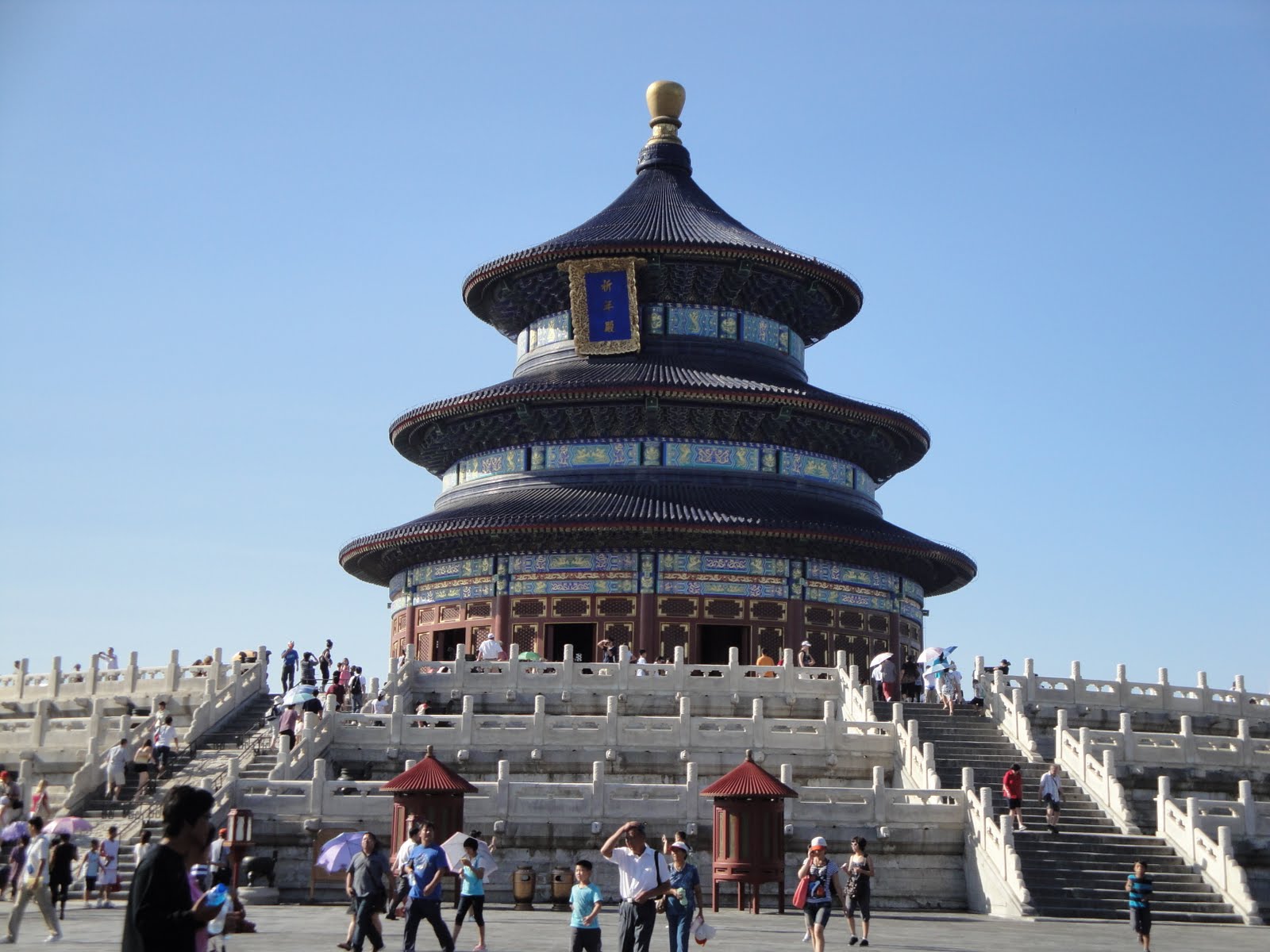
The Hall of Prayer for Good Harvests is the main attraction on this site and even the path leading to it is significant.

This sign explains the Danbi Bridge, which is the oldest overpass in the "ancient capital of Beijing".  It had separate walking areas for people based on social rank.


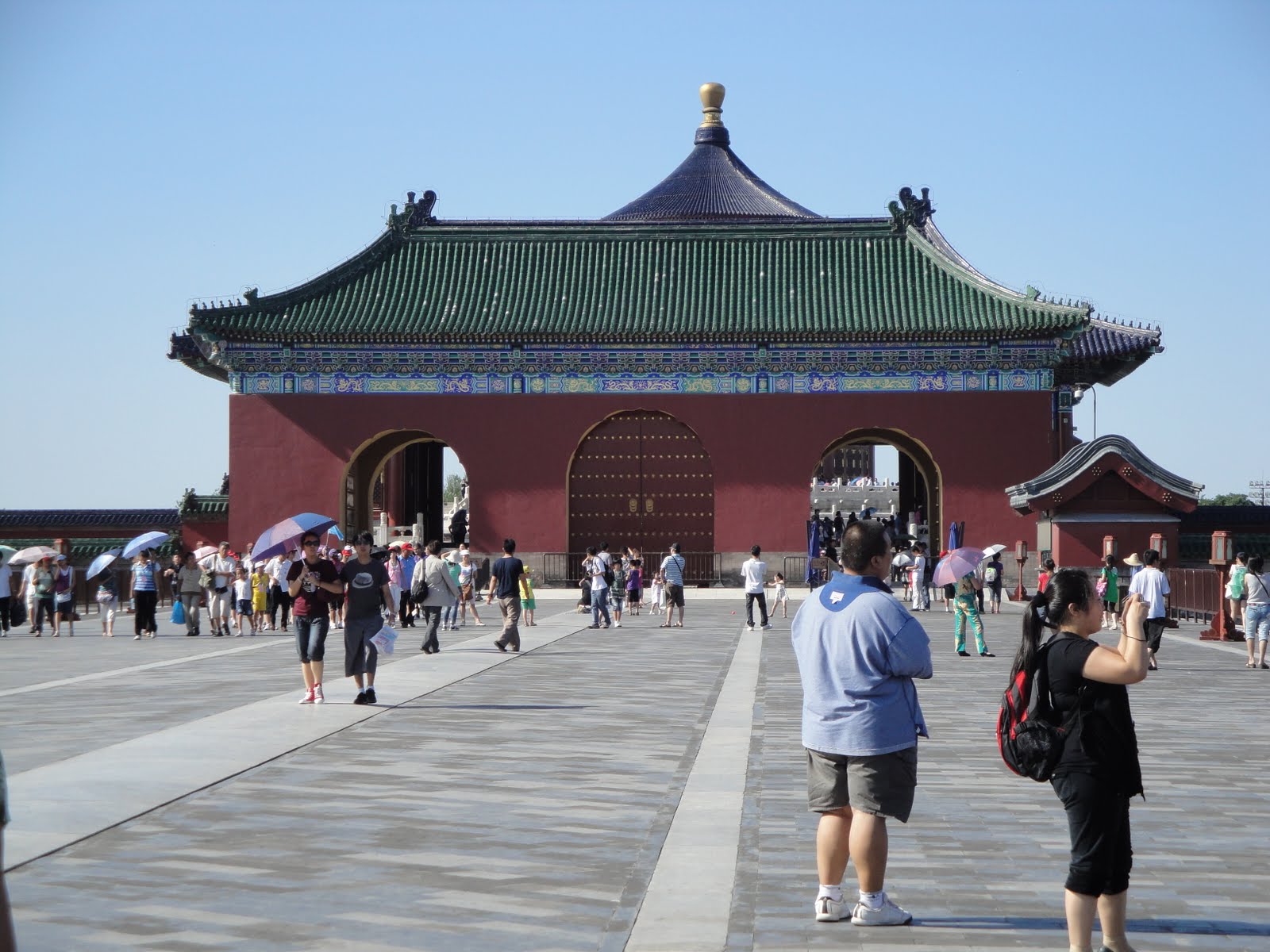
Next you  approach yet another set of gates to pass through and following that a kind of bridge building which would have been guarded, I presume.

The detail and color of all of these buildings is repeated throughout the site.  They have been restored to their originally intended color, which is much brighter than you might expect.  Much like when the Sistine chapel was restored and everyone thought it was too bright, despite records showing that those were the original colors.


Now, finally we get our first glimpse of the Circular structure of the Hall of Prayer for Good Harvests.  It is set an a circular marble structure, much like the altar mound, and the building is much larger in size than the Imperial Vault.


One is not allowed inside, but if you worm and crush your way into the front you can snap a picture over the heads of the other tourists.  I'm very tenacious ;)

More to come...

Temple of Heaven (3): The Temple Grounds

Surrounding the Imperial Vault are smaller, but equally beautiful buildings housing symbolic offerings and prayers. Knowing that nearly everything about this type of architecture is symbolic, its easy to begin reading into the meaning and purpose of everything.


The colors, quantities, shapes, directions and, of course animals or symbols depicted, all have specific meanings.  For instance, Earth is represented by a square and Heaven by a circle.  The number nine refers to the Emperor and the number twelve refers to the hours of the day and the months of the year.

The colors that seem to prevail over most of this type of architecture are also significant.  All of the buildings in the Temple of Heaven have dark blue roof tiles, which symbolize Heaven.  Red, generally considered a good luck color, also represents a fire element, which can chase out evil spirits.  Gold, or golden yellow, represents Earth, wealth and happiness.


Also on the Temple grounds are these precious protected trees which are hundreds of years old and also believed to hold special spiritual qualities.

Here is the "Nine Dragon Juniper", so called because of the spiral grooves encircling the trunk like "dragon writhing up to the sky".  Or, as the translation below says "wreathing" up to the sky ;).


More to come... 

Temple of Heaven (2): The Imperial Vault of Heaven


The second structure you encounter at the Temple of Heaven is the Imperial Vault of Heaven.  It is a circular structure like the Hall of Prayer for Good Harvests, which is the main attraction and resembles it in design.  

This is the sign above the entrance to the Imperial Vault of Heaven.  Notice the chicken wire to keep the birds from roosting in there.

 Here is the carving that goes up the steps leading to the from entrance (although they direct the tourists around the side, as you can see).


Below the carving is this sign.  I don't know what it says... maybe, "don't walk on the carving".


The Imperial Vault of Heaven is surrounded by an Echo Wall, which can transmit sound long distances, most likely used for prayer.  If you look closely at the wall you can see where people have scratched in graffiti.  I wonder if they are prayers or just "I was here" scrawls.


Inside, the first thing I noticed was the beautiful, intricate ceiling. Partly because It was so crowded you had to worm your way in to get a look at anything below head level.  Well, thank God for long arms (to hold up the camera) and determination.  I was able to squeeze in to get this picture of the inside, which contained some beautiful, symbolic offerings.  


More to come...