Showing posts with label Temple of Heaven. Show all posts

Friday, August 6, 2010

Street Scenes - Beijing: Bamboo Baby Bjorn


How much did you spend on that Baby Bjorn? Seriously.  Because this kid looks pretty content and I think I could make this for you out of Lincoln Logs.

Location: Temple of Heaven, Beijing.

Thursday, August 5, 2010

Temple of Heaven (4): The Hall of Prayer for Good Harvests

The Hall of Prayer for Good Harvests is the main attraction on this site and even the path leading to it is significant.
This sign explains the Danbi Bridge, which is the oldest overpass in the "ancient capital of Beijing".  It had separate walking areas for people based on social rank.


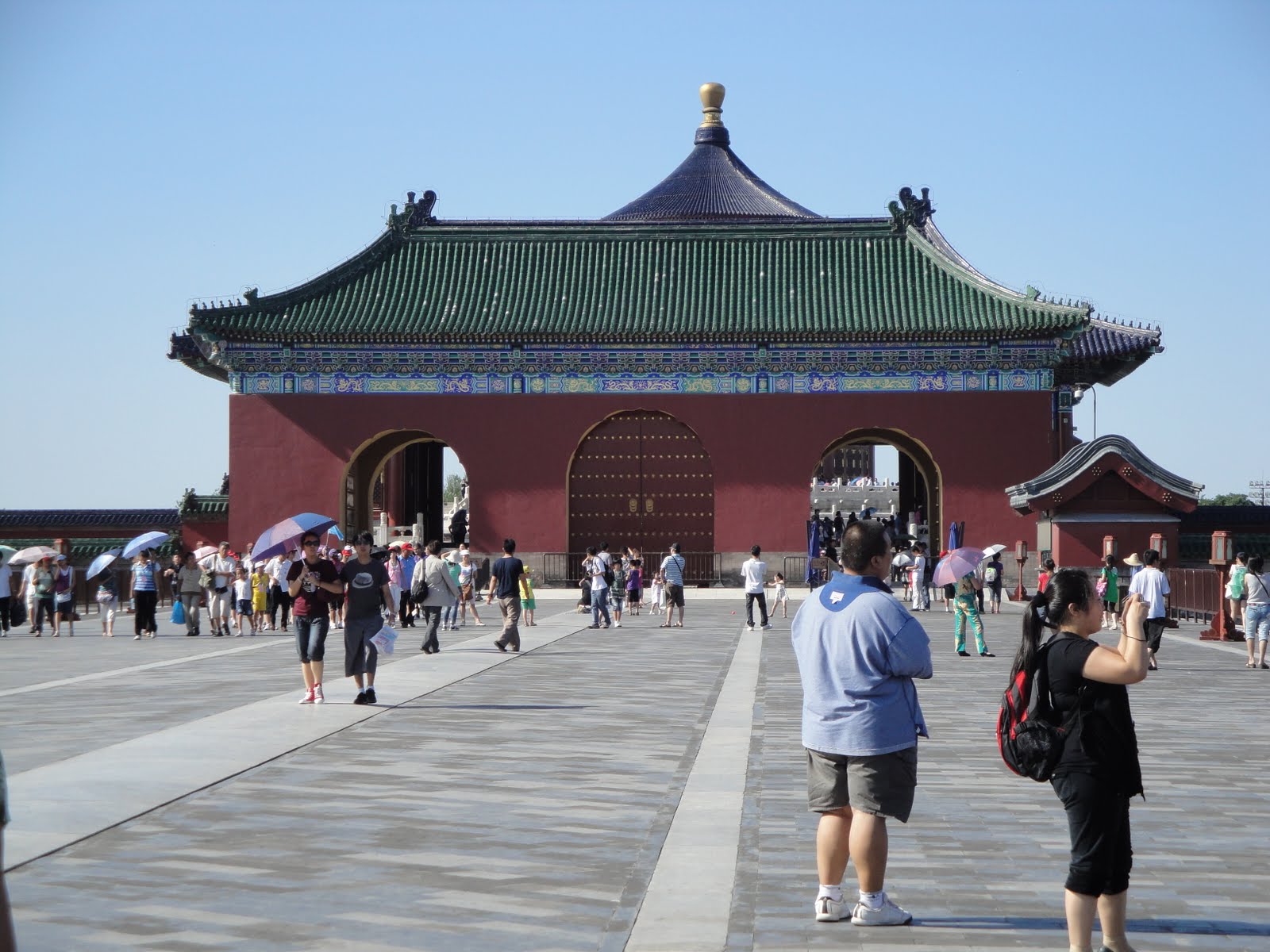
Next you  approach yet another set of gates to pass through and following that a kind of bridge building which would have been guarded, I presume.

The detail and color of all of these buildings is repeated throughout the site.  They have been restored to their originally intended color, which is much brighter than you might expect.  Much like when the Sistine chapel was restored and everyone thought it was too bright, despite records showing that those were the original colors.


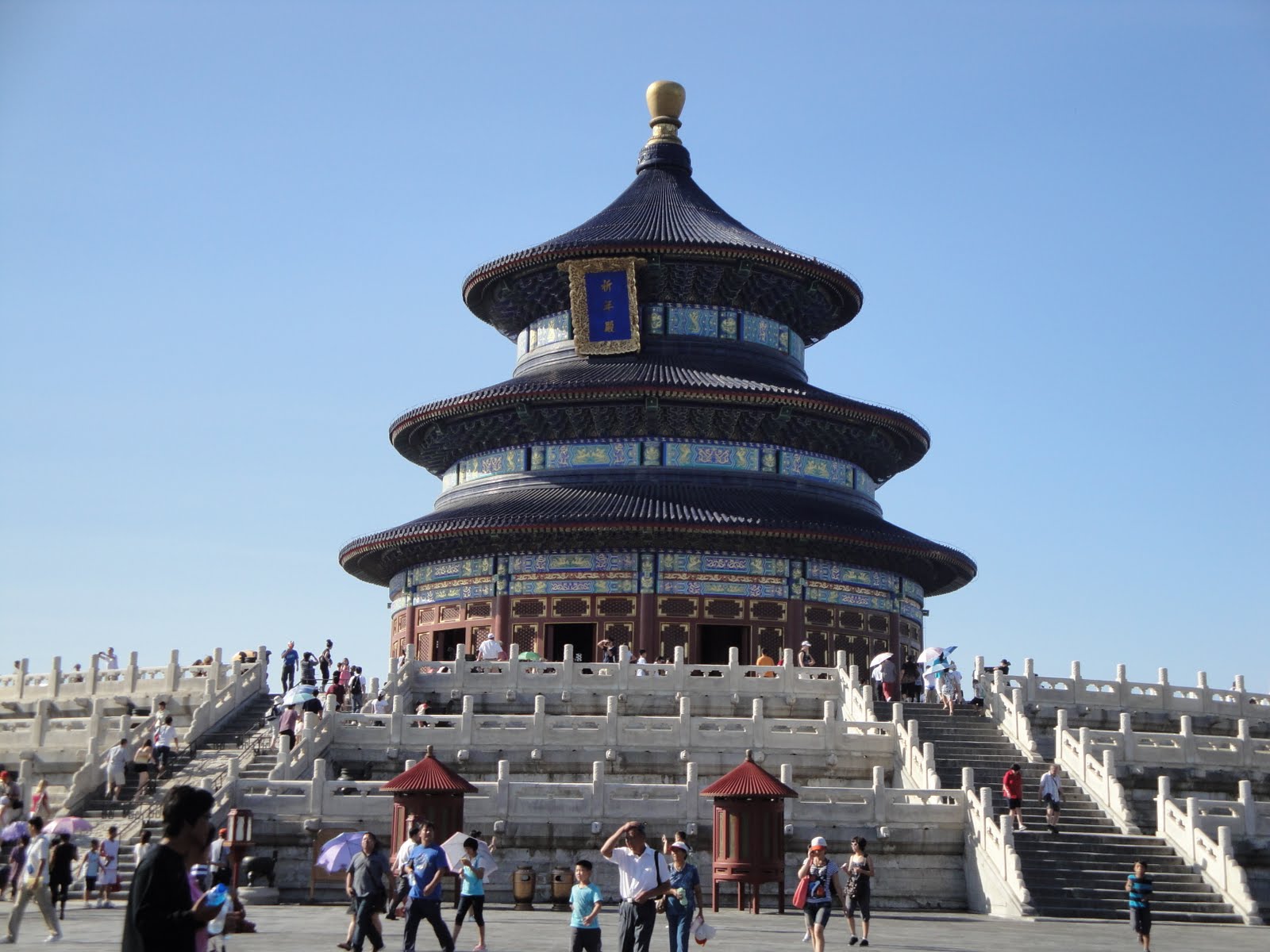
Now, finally we get our first glimpse of the Circular structure of the Hall of Prayer for Good Harvests.  It is set an a circular marble structure, much like the altar mound, and the building is much larger in size than the Imperial Vault.


One is not allowed inside, but if you worm and crush your way into the front you can snap a picture over the heads of the other tourists.  I'm very tenacious ;)

More to come...

Temple of Heaven (3): The Temple Grounds

Surrounding the Imperial Vault are smaller, but equally beautiful buildings housing symbolic offerings and prayers. Knowing that nearly everything about this type of architecture is symbolic, its easy to begin reading into the meaning and purpose of everything.


The colors, quantities, shapes, directions and, of course animals or symbols depicted, all have specific meanings.  For instance, Earth is represented by a square and Heaven by a circle.  The number nine refers to the Emperor and the number twelve refers to the hours of the day and the months of the year.

The colors that seem to prevail over most of this type of architecture are also significant.  All of the buildings in the Temple of Heaven have dark blue roof tiles, which symbolize Heaven.  Red, generally considered a good luck color, also represents a fire element, which can chase out evil spirits.  Gold, or golden yellow, represents Earth, wealth and happiness.


Also on the Temple grounds are these precious protected trees which are hundreds of years old and also believed to hold special spiritual qualities.

Here is the "Nine Dragon Juniper", so called because of the spiral grooves encircling the trunk like "dragon writhing up to the sky".  Or, as the translation below says "wreathing" up to the sky ;).


More to come... 

Temple of Heaven (2): The Imperial Vault of Heaven


The second structure you encounter at the Temple of Heaven is the Imperial Vault of Heaven.  It is a circular structure like the Hall of Prayer for Good Harvests, which is the main attraction and resembles it in design.  

This is the sign above the entrance to the Imperial Vault of Heaven.  Notice the chicken wire to keep the birds from roosting in there.

 Here is the carving that goes up the steps leading to the from entrance (although they direct the tourists around the side, as you can see).


Below the carving is this sign.  I don't know what it says... maybe, "don't walk on the carving".


The Imperial Vault of Heaven is surrounded by an Echo Wall, which can transmit sound long distances, most likely used for prayer.  If you look closely at the wall you can see where people have scratched in graffiti.  I wonder if they are prayers or just "I was here" scrawls.


Inside, the first thing I noticed was the beautiful, intricate ceiling. Partly because It was so crowded you had to worm your way in to get a look at anything below head level.  Well, thank God for long arms (to hold up the camera) and determination.  I was able to squeeze in to get this picture of the inside, which contained some beautiful, symbolic offerings.  


More to come...

Temple of Heaven (1): You are now entering the Temple of Heaven...

You are now entering the Temple of Heaven.  Your mission, should you choose to accept it, will be to try to take pictures that  do not include baseball hats.  Good luck.


Its summer, vacation season, and despite the fact that there are thousands of international tourists visiting these historical sites, there are even more Chinese tourists visiting.  With Westernization being what it is today (and the fact that baseball hats no longer require any association to the game of baseball) its virtually impossible to take a photo that does not have a baseball hat in it somewhere. Really.  Look closely and count them in the photos.  It could be a drinking game.

Oh well, I am taking photos document my trip, not to get published in National Geographic.  And besides, this is China as it is today.  Part of what I have enjoyed seeing is a culture incorporating input from around the world (well, limited input due to the Great Firewall of China, and other kinds of censorship) and blending those things into their own unique interpretation.  Even if I'm not down with all the baseball hats.


The Temple of Heaven is a complex of Taoist buildings in Beijing built between 1406 - 1420 by the Yongle Emporer, who also built the Forbidden City, so the style of architecture, colors and architectural details are very similar.  


The complex is as much landscape design as it is architecture, which you can see illustrated in this aerial map from Sacred-Destinations.com.  Both of which influenced design in the Far East for many centuries afterward.


After entering through two sets of gates, and crossing walkways with sections that include designated areas for people, depending on their societal class, you arrive at the Circular Mound Altar, where the Emperor prayed for good harvests.

    The Circular Mound Altar is a marble structure made up of three circular platforms.  It was built originally a in 1530 and re-built in 1740, so it was not part of the original design.  However, it is a distinguishing feature of the site and one hat sets it apart.  


According to Wikipedia, "The number nine represents the Emperor and is evident in the design of the Circular Mound Altar: a single round marmor plate is surrounded by a ring of nine plates, then a ring of 18 plates, and so on for a total of nine surrounding rings, the outermost having 9×9 plates".

Also, for some reason, people like to do the Titanic pose in the center of the top level.  So naturally, I must join in.  I should mention that this is listed as a "sacrificial altar", so I can only assume there were animal sacrifices of some kind?  I will have to research further.


Here is the view towards the rest of the complex...


Stay tuned for the next installment of the Temple of Heaven, featuring the Hall of Prayer for Good Harvests and the Imperial Vault of Heaven...