Showing posts with label Tiananmen Square. Show all posts

Friday, August 6, 2010

Tiananmen Square (4): The 1989 Protests and Massacre

Let's not leave Tiananmen Square without paying respects to the thousands of people who protested and died here in 1989.  Like many things in China, information about this event is censored.  They do not teach it in the schools so, much like the memory of the American internment of the Japanese-Americans in the US during WWII (which my family experienced), which was  swept under the rug, there is fear that future generations will not be aware of this important event in history.  

I remember this event and the world-wide news coverage playing on television and my very politically aware friends in outrage.  Although I was young and couldn't understand the full details of the event there were several things that stuck in my memory.  The fact that these were the people of China standing up to their own government.  A government that chose to fire openly onto crowds of unarmed civilians.  News cameras showed ambulances blocked from entering the are to help the injured and a few of the ambulance drivers were also shot by the government. Of the many people killed or injured that day many were innocent bystanders, not even involved in the protests, which you can see in this BBC video from 1989. Probably the most memorable image from this time was a man they called "Tank Man".  News cameras documented him standing alone in front of rows of tanks preparing to roll into Tianamen Square. 


(Photo by Jeff Widener)

The Chinese government does not acknowledge whether this man was killed either at the scene or as punishment for his offenses, nor do they confirm the exact amount of people killed.  The record from the Chinese Government listed 241 dead and 7,000 wounded, while their own Chinese Red Cross listed 2,600 dead by the next morning.  NATO listed 7,000 dead and the Soviet Union claimed 10,000 were killed.  Despite the discrepancies in the head count, the fact remains it was a cruel and unnecessary tragedy.  Tiananmen Square contains many important landmarks, has been host to numerous important historical events and is sure to be the the center of many more to come, but hopefully none that end in this kind of tragedy. You can read more about the Tiananmen Square protests and massacre here.

Tiananmen Square (3): Mausoleum of Mao Zedong


The Chairman Mao Memorial Hall, or the Mausoleum of Mao Zedong, as it is also known, stands on the previous site of the Gate of China that was demolished in 1954.

Although Mao requested to be cremated, he was embalmed after his death in 1976.  His body is displayed in a crystal coffin and people line up every day to view his body and pay tribute.

People from all over China contributed to the design of the Mausoleum as well as to the materials themselves including granite from Sichuan, pebbles from Nanjing and rock samples from Mount Everest.

The sculptures in front of the museum, sometimes called the Workers' Revolutionary Statues, are part of a group of four "teams", two in front and two in back of the building.  Altogether there are 62 figures measuring 3.5m.  


The entire group of sculptures took 5 months to complete by over 100 sculptors from 18 different provinces in China. 


Tiananmen Square (2): The Architecture and History

Tiananmen Square holds a lot of cultural significance due the political events that have occurred there, particularly the Tiananmen Square Protests in 1989, the proclamation of The People's Republic of China by Mao Zedong in 1949 and the May Fourth Movement in 1919. And that's just the last 100 years. (Pictured above: The Monument to the People's Heroes and the Great Hall of the People).


While the Tainanmen (Qianmen) Gate to the Forbidden City was built in 1417, the Square itself was not built until 1651.  In the 1950's it was enlarged to four times its original size, becoming the largest public square in the world (440,000 m² - 880m by 500m) and can accommodate up to 600,000 people.  

The Square lies between the Tian'anmen North Gate and the Zhengyangmen (Qianmen) South Gate which leads into the Forbidden city.  

Pictured here: The Monument to the People's Heroes.

On the west side of the Square is the Great Hall of the People (above) and the Monument to the People's Heroes  and on the east side is the National Museum of China (below), which focuses on Chinese history before the May Fourth Movement in 1919).


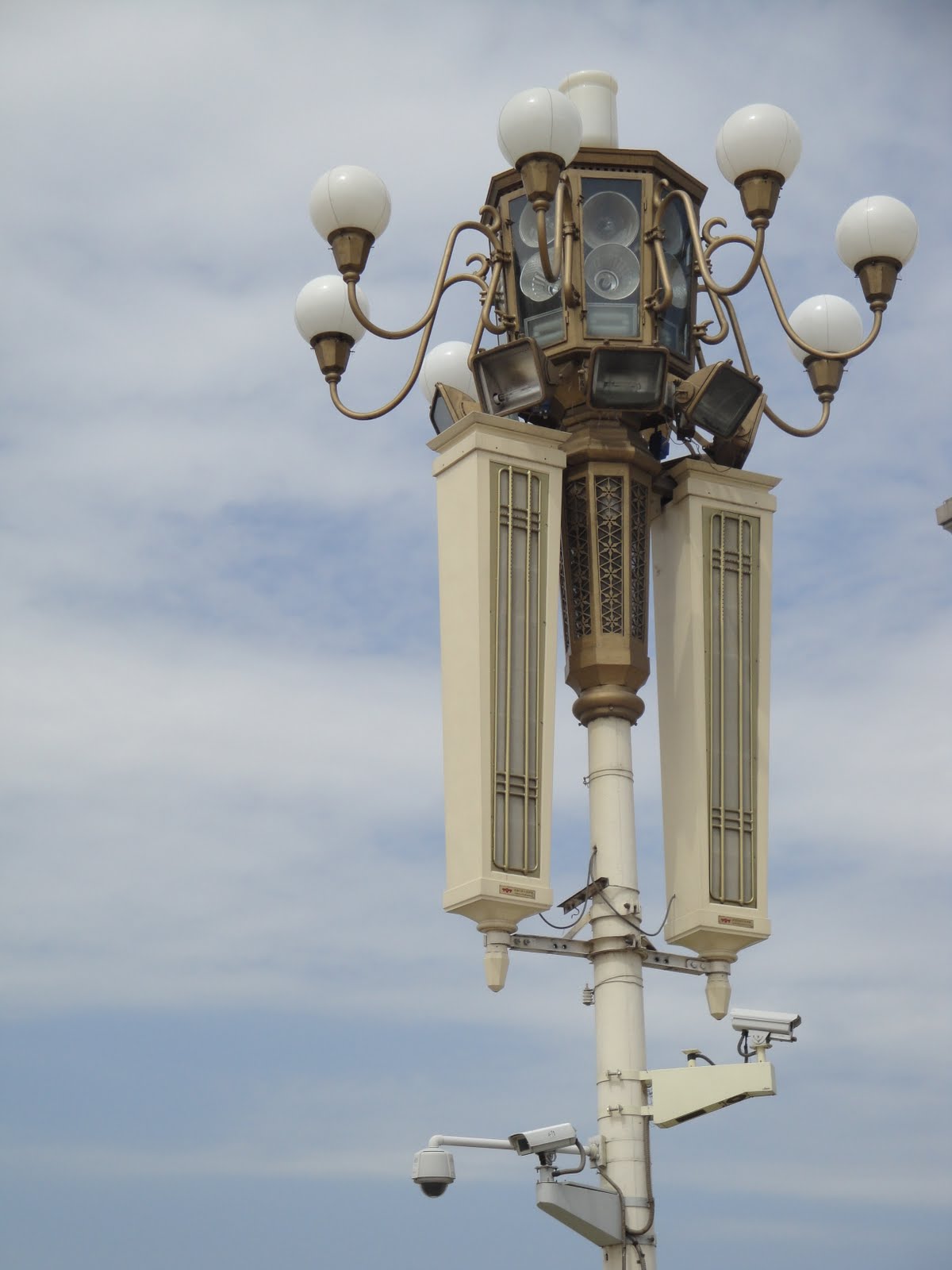
Another sign of China's continued control over monitoring the activities of its citizens can be seen here.  The lamposts here sport video cameras and policemen in uniforms and plainclothes patrol the area.  

Hmmm... I guess not so different from some Chicago neighborhoods, eh?


Tiananmen Square (1): Qianmen, The South Gate

Qianmen is the colloquial name for Zhengyangmen, which is the South Gate of Tiananmen Square. It once guarded the entry to the inner city and, after the walls were destroyed in the 60's, only the gatehouse and the archery tower remain.


It was originally built in 1419, during the Ming Dynasty and, after the Communist victory in 1949, it was occupied by the People's Liberation Army.  Since it was vacated in 1980, it has become a tourist attraction and the architecture is extremely well preserved.

As a military structure, its fascinating how much care was taken in designing the decorative details as well as the practical aspects.